Showing posts with label elderly. Show all posts

Sunday, July 17, 2016

Working BIG - Art with the Elderly

A facility where I teach is adding a new wing. The activities director decided there should be ART on the temporary walls. My Assisted Living class got one panel. So with short notice, on the fly, I drew flowers and dogwood blossoms, to create two work levels for my students. Most are in wheel chairs.
First brush strokes
The aides seated the class in a semi-circle. 
The effect was so relaxed: art as in-the-moment miracle, one you could relax and observe.
Painting together

The mural took three one-hour sessions to finish.
Two artists, side by side
What made it so fun? No one was totally responsible, for starters. Fine motor skills no longer mattered. Big marks were easier to see with older eyes. But I think it was also the thrill of the forbidden - how many of us long ago were told never to draw on the walls?
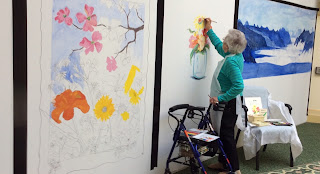
Our panel's on the left. Two more panels, center and right.

 In between sessions I filled in the big areas. Sky first, greens last. 
Finished!
 In another week or so, the sheet rock, and the paintings, come down. 
Someday, though,I'm painting on my own house walls.


Friday, February 26, 2016

Alzheimer's Art: Winter Scene


This week my Alzheimer's art group collaged winter scenes.
It is a stretch, to move them through three different concepts  - black trees, white snow, and collage - in one hour.
 But the hard work paid off. Each person found something that worked for them and pursued it. 

They finished happy, some so much so they stayed an extra 20 minutes, working or just talking about their art.


I always line the finished pieces up, and point out how good they look together. Then I  remind them that each piece is different, because each person is different.

One woman never says a word. But as she left, she turned to me and held out a last deer.

 "Would you please put this in the corner?" She gestured to a painting. I glued the deer down. "Thank you," she beamed.


Friday, February 19, 2016

With love

Some out-of-favor polka dots, skimmed with crimson and gold. Then a black-and-white text paper, veiled with crimson. Finally, lots of related circles from all these and more, using a Papertrey die so  hoop and circles match.  Little messages from tiny Papertrey stamps. Nice break on a quiet afternoon.

Last week, we made Valentines in Assisted Living. Something about all that pink brings out the best in everyone.
 Residents made cards. Staff joined in.  
"This should go on all day," declared the director.
 Cards were made for spouses, children, grandchildren. I talked one woman into making cards for her granddaughters in college. High point of my day.

The week before, I led Heart-Felt Collage at the Arlington Center for the Arts. 

So much loving creativity.

 And lots of paint.
Big hearts, creative people.  A great afternoon.

Thursday, February 11, 2016

Valentines

 Alzheimer's class this week. Brought in a slew of pinks, reds, and florals. Together we all glued the biggest doiley onto our papers. Then each resident had a free hand to work as they pleased. Folks work at such different paces. They keep me busy.

Everyone needs a little help, each a little differently.
For some, language is tangled, but the urge to communicate shines through.

As the hour goes by, each person's style emerges.

A quiet composition

Joyful abundance
Rich and symmetrical
This person always wants a balanced composition, and edited carefully, bringing me over to help hunt for hearts that matched.

We had a few minutes left at the end of class, so I started a final card with the word "cherish" and brought it to each person to add something. The newest resident reached into a pocket and produced the blue buttons and jewels. Everyday has its suprise.

Friday, January 15, 2016

First snow and tactile art


Home-made clay, sticks and old CDs = snowmen this week with my Alzheimer's art group. "They are all wonderful. And all different." Just like the folks who made them.,

Saturday, March 21, 2015

Art with the Elderly

"The house I grew up in" -- Joanne
The folks in my classes wrestle with more than age.  They face the blank page, not only in public and perhaps for the first time, but with dimmed eye sight, arthritic hands, and failing memory.

Through the magic of the internet, I discovered Jane Filer.  Filer's  combination of abstraction and whimsy inspired  my students like nothing I'd seen before. We used a detail from Filer's "Hillandale Road."


Even the simplest version catches the geometry and the rhythm of the trees.

geometry of landscape

This resident layered the watercolors for deeper hues, and added trees at the bottom.  
Vineyard view

This resident, an artist in her day,  had avoided my class, wrestling with doubt and self-consciousness. But Filer's artwork pulled her in. I love the pink she used for the fields.
Pink Hills

A woman who usually paints traditional decorative flowers worked on this image for three classes. "I've never done anything like this." Wonderful.
New Horizons, after Jane Filer "Hillandale Road"

  
Thank you, Jane Filer, for the inspiration. Find Filer's work, including "Hillandale Road," here. She is a joyous, sharing artist. Watch her at work here and here.

Thursday, October 16, 2014

Elder Art: Collage


Scraps from my studio become art supplies
I brought a pile of autumn-hued fabric scraps to my art classes this week.

Adding leaves to a painted ground

Folks were surprised  that fabric could be an art supply. They loved the colors, the textures. Several noticed the silks and the remnants of hand-dyed table cloths. This is the generation that treasured those linens. 

This student, usually hesitant, often disappointed, loved the process.

a rich scene

For the Alzheimer's patients, however, tasks remained discrete. Think about it: gluing is made up of many steps. It requires a sense of what is possible in the immediate future, and that's just what Alzheimer's robs away. 

Every student needed one-on-one attention to get anything glued to paper. Then, the collaged image didn't hold together in their eyes. "It looks like blobs. There's too much white."

 So we backed up and worked on the processes that made sense to each person.
Trimming a rough edge
Adding leaves to a painting
A bit of green linen for ground
Adding color to the background
One woman painted the tree's edges green.  I handed her a brush with orange paint on it, and she carefully over-painted all the leaves.
a second layer of color

 Then she painted the trunk orange. And smiled a huge smile.

I come home to world news and this work seems so small. But it requires time, attention, patience, creativity and quantities of love. We could all use more of that.

 "Your class is a constant in a sea of change," a director assured me. "What you do makes them happy. We see the effects for hours afterwards."


Thursday, September 25, 2014

Alzheimer's project: a Garden View

  
One of my employers asked for a project that was "anything fiber." She showed me pieces in the Assisted Living art room.  I could tell they had been made by more fully functioning hands and minds. How to bring the same processes to my Alzheimer's patients?


With Alzheimer's groups, abilities are all over the map.  I  wanted everyone, even those at the far ends of the spectrum, to feel success.


The Concerns that Shaped This Project

  • Impaired vision.  Alzheimer's can make it hard to interpret shapes. Dark objects on a light ground made designs easier to "read."
  • Arthritic hands. Don't assume people can (or can't) use scissors. I cut out leaves and flowers  defined enough to satisfy some folks, but loose enough to encourage others, who could, to "edit" them. Also, I brought my good fabric scissors.
  • Immobility. For many, movement is a struggle. After considering several ways to  make the project collaborative (rotate the pieces among students? Work together in the middle of the table?) I borrowed from the quilt tradition, and  pre-cut background squares to distribute.
  • Unreliable short-term memory.  A surprising lesson has been that gluing can confuse Alzheimer's folks. Too many steps. So I pre-fused all fabric and brought my own iron, then pressed each collage as it was finished.
  • The blank page problem. An empty page stops folks. To guide participants, I adhered "stems" to each block beforehand. This also embedded an over-all design, so the pieces worked well together.
  • Life in a locked ward. All those walls. I wanted this piece to feel like a virtual window.
I tested the idea with another class. Biggest discovery: The most mentally adept worked carefully, trimming shapes and perfecting placement.
More impaired students filled the page and finished quickly.
 
So I prepared lots of materials and brought at least two background squares for each artist. On the big day, each person completed at least one square. The most impaired artists finishing three pieces each. I wrote their names down on the pieces as they finished.

Several folks stayed afterwards, to look at the finished pieces. They marveled at how good everything looked together. We talked about different ways to organize them.  Amazing. For me, perhaps the most satisfying moment.


The next week, I sewed the squares together, fused and stitched the result to batting, then backed, bound and labeled it. I took the piece to a long meeting, where I embroidered the residents' names.  A sleeve and wired board readied it for hanging.

 
 It will look even lovelier when winter sets in.


Tuesday, July 22, 2014

Alzheimer's assignment

 The request: invitations painted by the residents, for an upcoming concert.  The artists: low-to-mid-functioning Alzheimer's patients.  Materials: watercolor concentrates, liquid tempra, glue. Plus one hour.

Song + summer led to sheet music and birds. So I've been experimenting this morning, looking for the best order of steps, asking myself how to stream-line instruction, and trying to anticipate where different residents will need help.
printed image, glued as rectangle, then painted

Printed image, trimmed, then glue and painted
 I think I'll go with more than one solution in my pocket. Teaching is so like theater. You never quite know how the audience will react, but you commit to bringing the solution home.
Music for belly, from Pinterest idea

 I like Music As Wings idea best.
Pencil drawing, painted with mix of white tempra and watercolor.

Maybe I can figure a way to have that text to add, too.